


Your board operates at the highest level of accountability in your organization. Bad tools at that level don't just cause friction, they create risk. Documents shared over email, minutes stored in personal folders, votes with no audit trail: these are governance failures waiting to be discovered. The question is not whether your board needs purpose-built software. The question is what that software genuinely needs to do before you commit to it.
The Problem With "Good Enough" Tooling
Many boards start with general-purpose tools. A shared drive for documents, a video call platform for meetings, an email thread for approvals. It works, loosely, until it doesn't. A director can't find the right version of a resolution. An auditor asks for a decision log and nobody can produce one cleanly. A new board member gets onboarded by being added to a folder and left to figure out the rest.
Board management software exists precisely to close these gaps. It consolidates meeting preparation, document distribution, voting, minutes, and governance records into a single controlled environment. That is the baseline. The harder question is what separates a platform that actually supports governance from one that simply digitizes the same paperwork problems in a slightly nicer interface.
What Actually Matters in a Board Platform
Security and Access Control
This is non-negotiable. Board documents contain material non-public information, strategic plans, executive compensation details, and legal correspondence. A platform that cannot demonstrate enterprise-grade encryption, granular permission settings, and a clear data residency policy should not make your shortlist regardless of its other features.
Look specifically for the ability to control access at the document level, not just the folder level. You want to grant a committee access to their materials without exposing the full board pack. You also want to be able to revoke access instantly when a director's tenure ends, and to know that revocation actually deletes access rather than just hiding a menu item.
Platforms like Diligent and Azeus Convene have built their reputations substantially on security credibility. That reputation matters because it signals that the vendor has been tested by enterprise buyers who genuinely scrutinize these controls.
Agenda and Meeting Pack Management
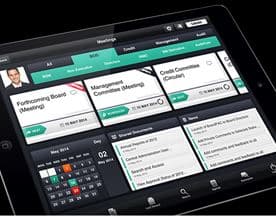
The most time-consuming part of board administration is typically building the meeting pack. A good platform should reduce that effort significantly, not just convert a Word document to PDF and send it out. Look for structured agenda builders that let you assemble sections, attach supporting documents at the item level, and distribute a clean, navigable pack in a consistent format every time.
The annotation and markup features matter here too. Directors read board packs on tablets, on planes, in the margins of other days. If they cannot highlight, comment, and bring their own notes into the meeting room, the platform is only solving half the problem.
OnBoard is one platform that leans heavily into the meeting experience from the director's perspective, which is a sensible design philosophy. The people who need to find value in the tool are often not the administrators building the pack but the directors consuming it.
Minutes, Voting, and the Audit Trail
Governance depends on records. Decisions must be traceable, votes must be documented, and the chain of custody for resolutions needs to be clear enough to survive legal or regulatory scrutiny. Many platforms handle minutes and voting, but the quality varies considerably.
In-platform voting with timestamped records and clearly identified participants is the standard you should hold any shortlisted platform to. Action item tracking that persists beyond a single meeting, so you can see what was agreed and whether it was done, is the feature that separates an administrative tool from a governance tool.
Govenda by BoardBookit and Aprio both put governance record-keeping near the center of their product design, which is worth noting during demos. Ask to be shown how a resolution is recorded, approved, and archived. That workflow reveals more about a platform's real capabilities than any feature list.
Onboarding and Ongoing Director Experience
Board members are not power users. They are often busy executives, trustees, or independent directors who attend four to twelve meetings a year and do not want to invest hours learning new software. If the platform requires significant training before a director can find a document or cast a vote, adoption will be inconsistent and you will end up managing workarounds.
Evaluate the mobile experience honestly. A platform that works beautifully on desktop but renders poorly on a tablet is a problem for a population that reads packs during travel. Offline access is similarly worth testing, since connectivity cannot always be guaranteed.
What You Should Probe in Demos
When you get to the demo stage, resist the tendency to let vendors show you their strongest features and move on. Push into the edges. Ask them to show you what happens when a director's access needs to be revoked mid-cycle. Ask them to walk through the process of correcting an error in a circulated pack. Ask about their uptime record and what support looks like on a Sunday evening before a Monday board meeting.
Support responsiveness matters more in this category than in most. Board meetings have fixed times. A platform outage or a critical bug in the hours before a meeting is not a minor inconvenience, it is a governance failure.
Also ask about integration with the tools your executive team and company secretary already use. Document storage, calendar systems, and entity management tools all intersect with board administration. A platform that plays well with your existing environment will drive higher adoption than one that creates a separate silo.







Making the Final Call
Price matters, but it should not lead the decision. Board software is protecting decisions that can be worth orders of magnitude more than the cost of the platform. The risk of inadequate governance tooling is asymmetric: the savings from choosing a cheaper platform rarely offset a single documented failure in the audit trail or a security incident involving board materials.
Start with a clear list of your non-negotiables around security, access control, and record-keeping. Then evaluate user experience for directors and administrators separately, because the needs are genuinely different. Use structured scoring across your shortlisted platforms and involve at least one director in the final evaluation. They are, after all, the primary users the tool is meant to serve.
The right platform will feel almost invisible to directors during the meeting and invaluable to governance professionals after it. That combination is what you are looking for.


