


Your hiring process is only as good as your ability to stay organized under pressure. When you have thirty applicants for one role, three roles open at once, and a hiring manager pinging you every other day for updates, the cracks appear fast. Spreadsheets get stale. Email threads fork. Candidates fall through without anyone noticing. This is the problem that candidate management software is built to solve, and understanding what it actually does (versus what vendors claim it does) makes the difference between a smart purchase and an expensive disappointment.
The Core Job, Stripped Back
At its simplest, candidate management software is a structured system for moving people from application to decision. It gives every applicant a record, every stage a definition, and every team member a shared view of where things stand. That is the irreducible value. Everything else — the analytics dashboards, the branded career pages, the AI-assisted screening tools — is built on top of that foundation.
Where buyers go wrong is evaluating the advanced features before confirming the foundation is solid. A platform that produces beautiful hiring reports but struggles to store consistent data across multiple job requisitions is not ready for serious use. Always establish that the core workflow is tight before you let a demo dazzle you with secondary capabilities.
What Separates Platforms Worth Buying
Once you have confirmed the basics, the meaningful differences between platforms come down to four areas.
Pipeline visibility
You need to see, at a glance, where every candidate sits across every open role. Not just how many applicants you have, but where each one is in the process and how long they have been there. Stale candidates are a real cost: roles that linger because someone forgot to advance or reject an applicant slow down your entire hiring timeline. Good pipeline visibility makes that kind of drift visible before it becomes a problem.
Collaboration and handoff
Hiring rarely happens in isolation. A recruiter sources and screens. A hiring manager interviews. A department head signs off. The software needs to support that handoff without creating friction or leaving decisions undocumented. Look for features like structured feedback forms, permission-based access for non-recruiter stakeholders, and notifications that keep the right people in the loop without spamming everyone.
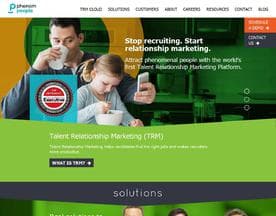
Phenom People takes a broad view of this problem, building tools that connect recruiter workflows to candidate-facing experiences and internal stakeholder communication in one system. It is worth understanding what that kind of integrated approach looks like if your organization runs complex, multi-stage hiring across several teams.
Candidate experience tools
A candidate who has a poor experience applying to your company is a candidate who tells others. Beyond the obvious reputational point, candidate experience features (branded application portals, automated status updates, clear confirmation emails) also reduce the administrative burden on your team. Fewer "just checking in" emails from applicants means more recruiter bandwidth for actual recruiting.
Candidate Manager is one example of a platform that emphasizes the candidate-facing side of the equation alongside the recruiter-facing side, which matters if employer brand is a priority for your hiring strategy.
Reporting that connects to decisions
Hiring data is valuable only if it changes how you operate. Metrics like time-to-fill, source-of-hire quality, and stage-by-stage drop-off rates help you figure out where your process breaks down and where it holds up. Platforms that give you configurable reporting (so you can ask your own questions rather than just read pre-built reports) tend to serve experienced recruiting teams better than those with fixed dashboards.
Talenthub leans heavily into this area, positioning candidate data and feedback analytics as its core strength rather than an add-on. If your team is trying to improve a process rather than just manage one, that framing is worth exploring.
Scale Matters More Than You Think
One of the most common buying mistakes we see is choosing a platform at current scale and then suffering when hiring volume grows. A tool that works elegantly for ten concurrent candidates may buckle at a hundred. This is not just a performance question; it is an organizational question. More candidates means more recruiters, more hiring managers, and more complex permission requirements. Make sure any platform you are seriously considering can handle the version of your team that exists in two years, not just the one that exists today.
360Candidate and Cynaptx both serve markets where high-volume or education-sector hiring creates distinct operational demands, which illustrates how much the "right" platform depends on the shape of your hiring, not just the size of it.
Integration Reality
Most hiring teams do not operate in a standalone system. You have an HRIS (human resources information system) for employee records, a payroll platform, possibly a background check provider, and likely some form of communication tool for coordinating interviews. Candidate management software that does not connect cleanly to those adjacent systems creates manual work that cancels out the efficiency you bought it for.
Before committing, map out the three or four integrations that are genuinely non-negotiable for your team, and test them properly during any trial or pilot period. Do not take a vendor's word that an integration "works." Run a realistic workflow end to end and see what breaks.

What the Buying Process Should Look Like
Define your current process before you look at software. Write out every step from the moment an application arrives to the moment an offer is accepted. Identify where things go wrong, where things get slow, and where visibility is weakest. That document becomes your evaluation framework. Every platform you assess should be measured against those specific failure points, not against a generic feature checklist lifted from a review site.
Run a real pilot with a live role if at all possible. Synthetic demos do not reveal the friction that appears when real candidates, real hiring managers, and real deadlines collide.
The right candidate management software does not transform a broken hiring process. It amplifies the process you already have, good or bad. Fix the fundamentals first, then find a platform built to support them.


