


You've probably seen the pitch before: unlimited resources, instant setup, and prices that feel almost too reasonable. Most hosting providers sound identical until something breaks, scales badly, or turns out to be wrong for the software you're actually running. That's when the differences become painfully clear. If you're evaluating application hosting for the first time, or reconsidering a provider you've outgrown, this guide cuts through the surface-level comparisons and focuses on what actually matters.
Why Application Hosting Deserves More Scrutiny Than Web Hosting
There's a meaningful distinction that buyers often gloss over. Web hosting serves files and pages. Application hosting runs software, which means it needs to handle persistent processes, database connections, session state, and sometimes serious compute loads. A provider that's excellent for a marketing website may be completely wrong for an ERP system, accounting platform, or industry-specific application that your entire team depends on every day.
The stakes are different, too. When a website goes down, it's embarrassing. When a hosted application goes down, your operations stop. That pressure should shape how you evaluate providers, not just what tier of plan you buy.
The Four Dimensions That Actually Separate Providers
Most buyers compare specs: CPU, RAM, storage. Those numbers matter, but they don't tell you nearly enough. Here are the four dimensions worth scrutinizing carefully.
Performance Under Your Specific Workload
Generic benchmark numbers don't predict how a provider will perform under your actual usage patterns. A platform optimized for high-concurrency web traffic will behave differently from one tuned for a single-tenant accounting application running through a Citrix-style environment. Ask providers what types of applications they host most frequently, and look for evidence that their infrastructure matches your use case rather than the average customer's.
Latency matters here, too. If your team is geographically distributed, the distance between users and the hosting environment creates real friction. Providers with data centers in relevant regions, like Canadian Web Hosting for teams operating in Canada, give you a practical advantage that spec sheets won't show.
Security and Compliance Fit
Application hosting carries a different security surface area than static hosting. You're dealing with authentication flows, data persistence, user permissions, and potentially regulated data depending on your industry. Before signing a contract, get specific answers on encryption at rest and in transit, access controls, vulnerability patching cycles, and audit logging.
If your business operates in a regulated sector (healthcare, finance, legal), compliance requirements add another layer. Some providers specialize in environments that meet specific standards, and that specialization is worth paying for rather than retrofitting compliance onto a general-purpose host after the fact.
Support Quality and Response Commitment
This is where commodity thinking does the most damage. A low monthly price means nothing if a critical issue takes 48 hours to resolve and your application is inaccessible the whole time. Push hard on support specifics: What are the actual response time guarantees, not aspirational targets? Is support included in the base price or metered separately? Do you get a named contact or a rotating ticket queue?
Providers like Elucentra Cloud Services and Summit position themselves around managed support and specialist knowledge, which matters if your internal IT capacity is limited. The value of knowing there's someone accountable on the other end compounds over time, especially during growth phases or software upgrades.
Scalability Without Renegotiation
Growth shouldn't require a contract crisis. Some providers make it genuinely easy to add resources, users, or instances as your needs change. Others lock you into a tier structure that forces a costly upgrade conversation every time your usage ticks up. Ask explicitly how scaling works, what it costs, and how much notice you need to give. The answer reveals how the provider thinks about long-term relationships versus initial sales.
Managed vs. Unmanaged Hosting
This choice shapes everything downstream, so it's worth settling early in your evaluation. Managed application hosting means the provider takes responsibility for the underlying infrastructure, patching, monitoring, and often application-level maintenance. Unmanaged hosting gives you more control and typically lower cost, but places the operational burden squarely on your team.
For most small and mid-sized businesses without a dedicated infrastructure team, managed hosting is the sensible default. The cost difference rarely outweighs the risk of running your own environment without the expertise to maintain it properly. If your team has strong technical depth, an unmanaged or hybrid arrangement gives you more flexibility and avoids paying for management you don't need.
Application-Specific vs. General-Purpose Providers
One underrated consideration is whether a provider specializes in hosting particular applications or platforms. A general-purpose cloud provider can host almost anything, but a specialist has likely solved the operational problems specific to that software already: tuned configurations, known compatibility issues resolved, optimized backup routines.
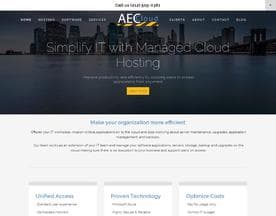
AEC Cloud is an example of this kind of specialization, focusing specifically on hosting for architecture, engineering, and construction software. If your use case is that specific, a specialist often delivers a faster setup, better performance, and more relevant support than a generalist who needs to learn your stack on your dime.
Red Flags Worth Walking Away From
A few patterns in the evaluation process should give you pause regardless of price or reputation.
Vague SLAs (service-level agreements) that promise "high availability" without a specific uptime percentage are a classic evasion. A serious provider defines uptime in numbers and backs it with credits or consequences. Similarly, be skeptical of providers who can't give clear answers about where your data physically resides, especially if you have data residency requirements.
Watch for providers who make cancellation intentionally difficult or obscure data export processes. A confident provider makes it easy to leave because they expect you to stay. One who buries exit terms in contract language is telling you something important.









Making the Final Call
Narrow your shortlist to two or three providers who pass the functional tests above, then run a structured pilot before committing. Give each provider a real workload, a real support scenario, and a real question about your roadmap. How they respond under low-stakes conditions is a reasonable preview of how they'll behave when the pressure is on.
The goal isn't to find the cheapest option or the most feature-rich platform. It's to find the provider whose operational model, support culture, and infrastructure fit are genuinely aligned with how your business runs. Get that match right and the hosting decision becomes something you don't have to revisit for years.


